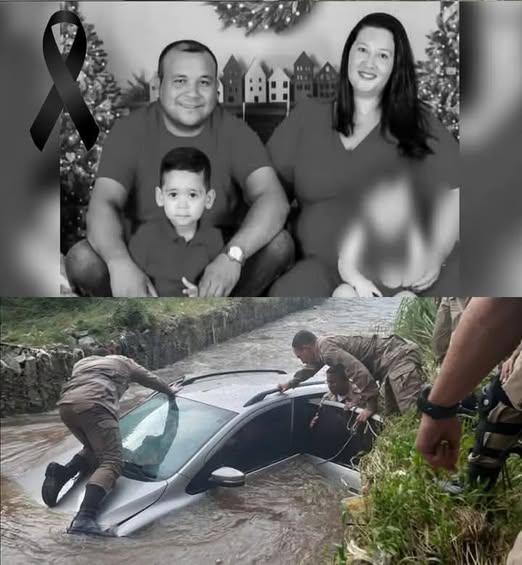
On the morning of Sunday, July 16, the peaceful Cariri region of Brazil awoke to devastating news.
A young family — 26-year-old Hérida Nascimento da Silva, her husband Sebastião Cícero Gomes, and their 3-year-old son, Miguel Nascimento Gomes — lost their lives in a car accident along the CE-060 highway, between Caririaçu and Juazeiro do Norte.
Their car was later found submerged in a river, the three still inside. What began as a hopeful trip ended in heartbreak that has shaken an entire community.
A Trip Meant for Healing
According to reports from TV Verdes Mares and the Ceará Military Fire Department, the family left their hometown of Várzea Alegre early that morning. They were driving to Juazeiro do Norte, where little Miguel was scheduled for a minor surgical procedure.
The journey was supposed to bring comfort and relief — but tragedy struck before they ever reached the hospital.
Authorities believe the accident occurred around 7 a.m., near the rural area of Sítio Piripiri. For reasons still under investigation, their vehicle veered off the road and plunged into a stream about five meters deep. The current was strong, and by the time help arrived, it was too late.
The Scene and the Silence
Firefighters worked for hours to recover the car and bring the victims to shore.
“It was heartbreaking,” one firefighter told reporters. “You could tell they were just a simple, loving family — and then, in seconds, everything was gone.”
Investigators continue to examine possible causes — slick pavement, a curve near a narrow bridge, or mechanical failure. Locals note that the CE-060 has long been known for fatal accidents, with poor lighting, fading lane markings, and missing guardrails making it one of the region’s most dangerous stretches of road.
A Community in Mourning
For residents of the Cariri region, the loss feels deeply personal. The CE-060 connects small towns to Juazeiro do Norte, the region’s main hub for medical care, education, and commerce. It’s a vital road — and a risky one.
Friends remember Hérida as a cheerful young mother who sold produce at the local market and loved caring for her son. Sebastião, a truck driver, was known for his generosity and willingness to help neighbors. Miguel, just three years old, was the light of their lives — bright, curious, and adored by everyone who knew him.
“They were such a loving family,” said one close friend. “They had dreams for Miguel. They wanted him to have a good life. It’s unbearable to imagine that they’re gone.”
The funeral in Várzea Alegre drew hundreds — friends, relatives, and strangers alike. Three coffins side by side, wrapped in flowers, became a painful image that no one will forget.
Calls for Change
Local officials renewed appeals for urgent road repairs. “This is one of many tragedies,” said a city council member. “We can’t keep waiting for lives to be lost before acting.”
The Ceará State Highway Department (DER-CE) acknowledged that parts of the CE-060 are in poor condition and said assessments are underway. But residents remain skeptical, recalling years of unfulfilled promises.
“Every time someone dies, they promise improvements,” said one shop owner near the crash site. “Then the road stays the same.”
The Human Cost
Beyond the reports and statistics lies a deeper wound — the emptiness left behind.
The couple’s home now stands silent: toys scattered on the floor, a child’s red tricycle resting against the wall. Neighbors recall seeing the family just days before, laughing as Miguel rode up and down the street.
One firefighter who helped retrieve the vehicle said quietly,
“When I saw the little car seat in the back, I had to stop. You can’t prepare yourself for something like that. It makes you think about your own kids — how fragile everything really is.”
Remembering What Was Lost
In Várzea Alegre, a small memorial now stands beside the river — candles, flowers, and a photo of the family smiling together. For those who knew them, it’s a place of prayer and remembrance, a symbol of love that endured even in tragedy.
The story of Hérida, Sebastião, and Miguel is not just a headline. It’s a reflection of countless families across Brazil — people who travel long distances for healthcare, education, or work, often along roads that fail to keep them safe.
Their story reminds us that behind every statistic is a home left quiet, a child’s laughter silenced, and a love that once filled the air of an ordinary Sunday morning.
